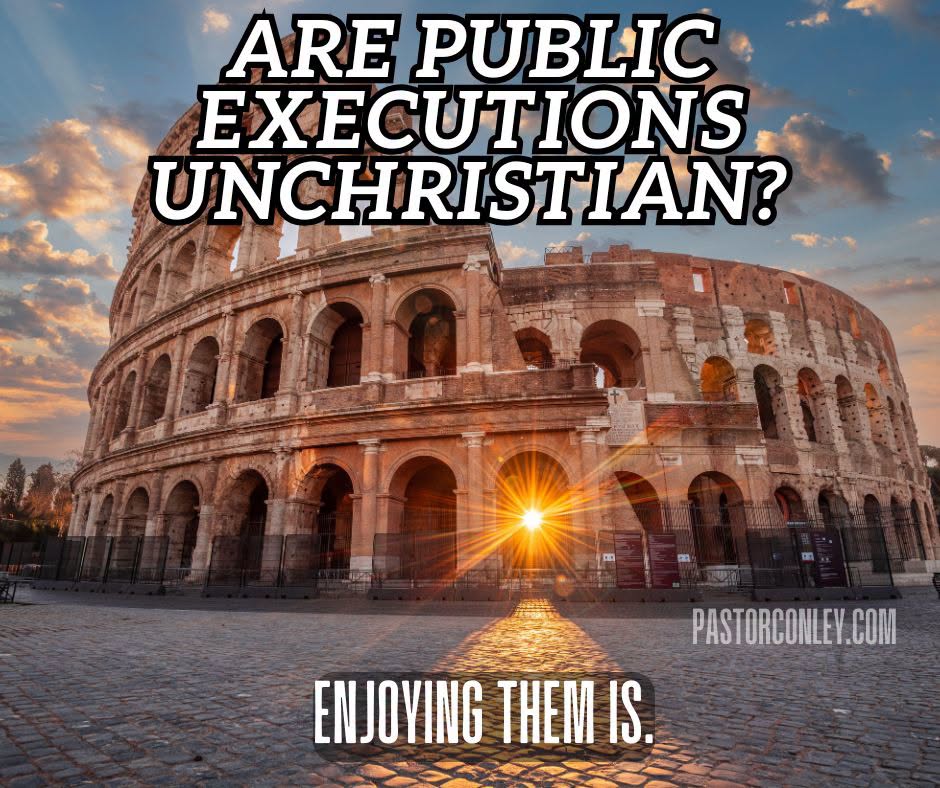
Public executions are not unchristian. Enjoying them is. To the modern ear, that couplet sounds like a barbaric contradiction. The progressive recoils, insisting that our civilization has grown beyond such antiquated brutality. Conservative populists may cheer the first sentence while failing to acknowledge the weight of the second. Both have lost their grip on the theological underpinning needed to navigate our fallen world while holding the necessary tension of Christian grace and absolute moral truth.
The decay of the West is accelerating, and traversing the growing chaos demands that we abandon sentimental, illusory notions of justice and return to the classical Christian view of order, the Imago Dei, and the terrible power wielded by the state. The believer should celebrate justice while weeping over the situations that demand it and the soul upon which it is carried out.
Sanitized Reality
For a century, we have treated the execution of justice as if it were merely a medical procedure. The death penalty has been carried out in hidden rooms before tiny, hand-selected audiences. Even our method—using a lethal injection of barbiturates and paralytics to end the life of the condemned while they lie strapped to a gurney under cold lighting in a sterile chamber—has been a deliberate attempt to sanitize the reality of the moment. This is not enlightened compassion on display; it may even be called the bureaucratic cowardice of a society that desires the security of the sword while eschewing the burden of seeing it draw blood.
Christianity argues that the civil magistrate is tasked with ending life by authority delegated by God Himself (Romans 13). If this is the case, we should not quickly dismiss the idea of a public execution. It could be argued that hidden executions are the breeding ground of tyranny—at least as much as some argue the same regarding public proceedings—and that they shield the people from the weight of their own laws and the reality of the power borne by those who enforce the law. Hidden justice reduces moral reality to an administrative operation. Public execution requires the weight of the law, and the visceral reality of its consequences, to be borne by the society as a whole. It demands that we take in the full, bloody toll of evil’s cost and not look away.
Further, Christians reject heretical thinking that attempts to dismiss the God of the Old Testament. We recognize that Yahweh Himself commanded executions that were carried out in the glaring light of the public square. Thus, in this strict sense, the demand for transparent justice is consistent with Christian thought.
God’s Way
It is also important that we reject the theology claiming that capital punishment itself is against Christian thought. Before there ever was a Mosaic law, God established the penalty for murder when He said, “Whoever sheds the blood of man, by man shall his blood be shed, for God made man in his own image” (Gen. 9:6).
The humanist would say we should abolish capital punishment because life is valuable. God says we must carry out capital punishment because life is valuable. To destroy an innocent bearer of God’s image is such a horrific crime that the only just response is for the murderer to surrender their own life. In carrying out the punishment, the state is not enacting personal vengeance; it is operating as God’s agent of divine wrath against evil.
Not as the Heathen
The reality of God’s wrath and delegated authority does not mitigate the agony the Christian heart feels when discussing this topic. To be clear, the topic is difficult, and Christian theology does not demand that every execution be public, especially in a world that turns the most serious events into fodder for internet memes and where public martyrdom is often a goal of the condemned. However, we must reject the idea that public execution is inherently unchristian. This is the tension of Christian thought. While we appreciate the necessity of the magistrate bearing God’s sword, we also realize we are forbidden from reducing it to frivolous entertainment.
Valuing justice is Christian; reveling in a spectacle of vengeance comes from a much darker place in the heart. When a society decides that an execution is a moment to find enjoyment in the death of the condemned—when we turn the ending of life into a spectacle for tailgating and watch parties—we have abandoned God’s justice and become a modern reiteration of the Colosseum’s bloodlust.
We must never lose sight of the reality that the man facing the executioner, no matter how wicked his crimes may be, is still an eternal soul. He is a broken masterpiece of God’s design. The Christian posture regarding his execution is not exuberance; it is solemnity. It is the realization that the same seeds of wickedness lie within each of us, and but for the grace of God, we could share that same end. Yes, we see this moment as justice being satisfied, but we mourn the reality that it is necessary.
Christian Courage to Be Different
We must refuse to align ourselves with the world’s polarized views. Christians are not the therapeutic liberals who excuse evil as the mere outgrowth of sociological pressures with no responsibility to be borne by evildoers. Christians are also not the reactionary populists who call for the unleashing of the mob.
To think about this topic like a Christian requires something far more serious than the politicized opinionating of the pundits. It calls for intellectual rigor and moral fortitude that demands justice for the innocent while weeping over the ruination of the guilty soul. We defend the magistrate’s sword, but we watch its swing through tearful eyes. We long desperately for the return of our King and the new creation He has promised, when our groaning can cease and the executioner will be needed no more.
Don’t miss any of the latest content from pastorconley.com Enter your email address below to have all the latest content delivered directly to your inbox FIRST and FREE!


Leave a Reply